


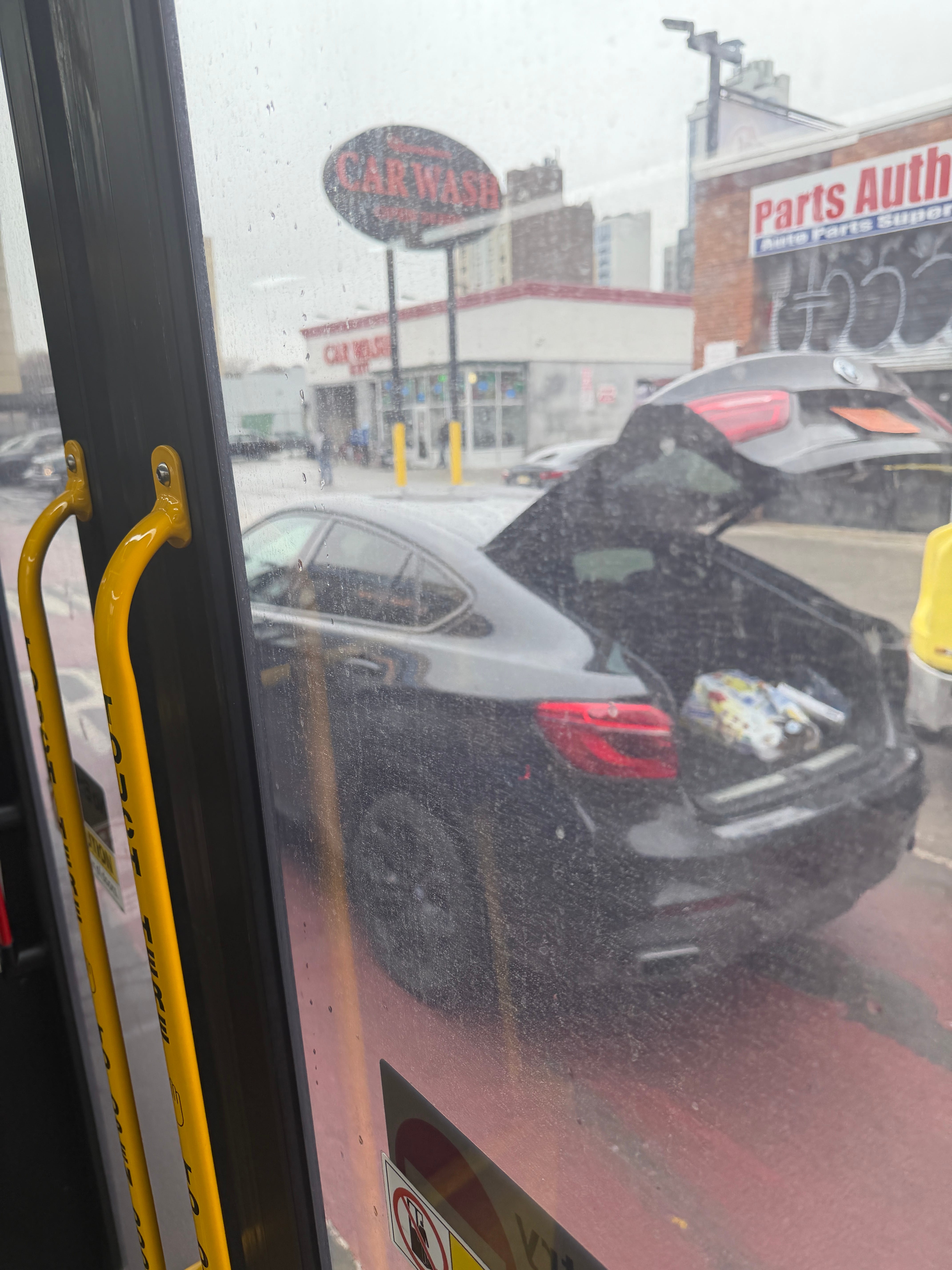
Obstructed bus lane on 21st Street
It’s 8:15 am in Astoria, and I rush out of my apartment to catch the bus on 21st Street.
At the stop, 30 of us are already waiting.
We stare at a bus about five blocks away, snarled by traffic, zigging out of a bus lane filled with double-parked cars.
When it finally arrives, it pulls into a giant, mushy snow pile. The bus is nearly full.
Boarding is excruciatingly slow; we spend 3 minutes squeezing. Many riders are unable to board. They are the unlucky left-behinds.
Before the clock even hits 9 am, New York policymakers have made a decision about your time. You will probably be late for work.
This isn’t a random bad morning. This is a system: long headways, traffic-clogged streets, and poorly implemented services. The collision of bad policy choices congealed into a miserable morning.
Our bus system exposes where our transit system can be better and how we should reprioritize our city streets. Many view the bus system as secondary, but buses move 1 million New Yorkers every day; unfortunately, 30% of buses in New York are late.
But if improved, buses have the potential to dramatically upgrade how we get around and challenge us to use our streets more wisely.
The bus lane that isn’t
Buses in New York move at a glacial 8 MPH, that’s thousands of riders stuck in traffic each day, basically planned congestion. Only 163 miles of the city’s 6,000 miles of streets have dedicated lanes of any kind, about 3% of our street network. And where we do have bus lanes, they are often insufficient and poorly enforced.
Since time immemorial, politicians have promised New Yorkers a cadre of bus investments: new bus lanes, express routes, and frequent service. But the improvements are constantly watered down by old-school thinking.
This is how my bus route on 21st Street ended up with the dysfunctional lane. The corridor had been studied for years to improve pedestrian and transit access. Finally, in 2021, the city began moving forward with a bus lane along this 2-mile corridor, which serves roughly 30,000 people per day and connects northern Astoria to transit hubs in Long Island City.
But when push came to shove, the city backed off its plans for separate, dedicated bus lanes that the local community supported and would have delivered faster buses.
Drivers complained, with one angry resident stating, “I know there are people who want everyone to use bicycles, but that is not feasible.” Department of Transportation Officials scuttled the center median lane, saying it would be nearly impossible to do.
What makes this most striking is that, during the study period, the Department of Transportation found that at many intersections on 21st Street, there were more pedestrian crossings than vehicles, but we ended up designing the street for cars anyway. Astoria got curb lanes–easily blocked, and less effective than the proposed center median lanes.
The plan was scaled back deliberately to a less effective method and would inadvertently prove bus haters right, as NIMBY’s could point to a broken bus lane as evidence that the city can’t get anything right. This is where we lose the plot.
Redesigning City Streets for People
But the deeper problem isn’t just that we compromised on one bus lane. It’s that we never changed the street it runs on or the mindset shaping it.
We keep trying to fix transit while leaving everything else the same: the parking, the traffic, the constant competition for space.
So the bus ends up doing what it always does: arrive late and sit in clogged lanes.
But when we successfully redesign our streets for transit, it works. Bus lanes in New York City can reduce travel times for customers by 47%. That’s huge. To make this point even starker, a bus lane can move 8,000 people per hour, compared with 1,600 in a car lane. We know what works. We just don’t build it.
Why Does this Matter?
Our commutes are often our most universal civic experience. Transit is where governance becomes tangible and where small improvements have outsized impacts. The simple act of tolling cars below 60th street took 73,000 cars off the road in Manhattan.
The big question is, how do we bring smart, high-yield improvements beyond Manhattan and into outer-borough neighborhoods? The next step for New York transit is not another study. It is to pilot and pioneer low-traffic neighborhoods.
If we want a better transit system, it starts with designing our neighborhoods for the people who live in them.